Women's Right to Vote: The 19th Amendment
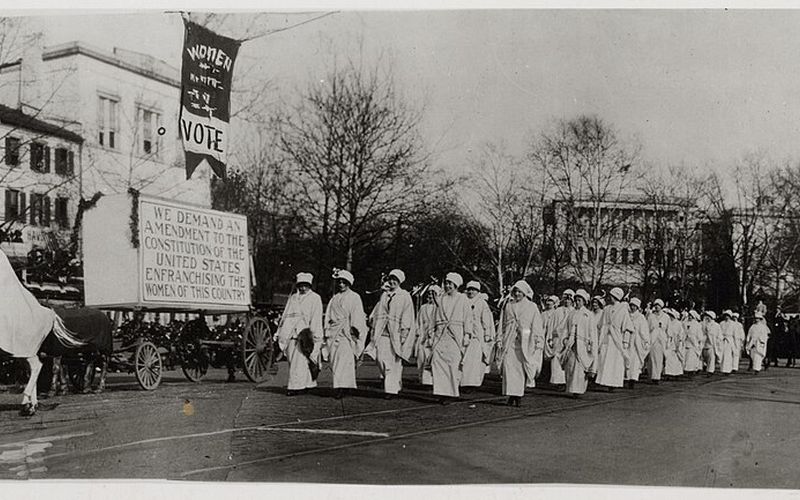
Seventy years after the Seneca Falls Convention, the suffrage amendment reached the floor of Congress during World War I. It passed the House in January 1918 but failed twice in the Senate. After the 1918 elections, the new 66th Congress passed it in both chambers within two weeks.
Resulting law: 19th Amendment to the U.S. Constitution
From event to law
Who voted against giving women the right to vote? Open any vote below to see every legislator.
- EventJuly 19, 1848
Seneca Falls Convention
The first women's rights convention in the United States calls for women's right to vote.
- EventJanuary 10, 1878
Amendment first introduced
Sen. Aaron Sargent (R-CA) introduces the amendment. It is reintroduced in nearly every Congress for four decades.
- VoteJanuary 10, 1918
House passes it
H.J. Res. 200 passes the House with almost exactly the two-thirds it needs.
House, 65th Congress, roll call 69
272 yea136 nayPassedTwo-thirds needed: 272 of 408
See how every representative votedParty Yea Nay Democrat 103 101 Republican 164 34 Progressive 2 1 Prohibitionist 1 0 Ind. Republican 1 0 Socialist 1 0 - VoteSeptember 30, 1918
Senate rejects it
President Wilson addresses the Senate in person to urge passage as a war measure. The vote falls short of two-thirds.
Senate, 65th Congress, roll call 325
53 yea31 nayFailedTwo-thirds needed: 56 of 84
See how every senator votedParty Yea Nay Democrat 26 21 Republican 27 10 - VoteFebruary 10, 1919
Senate rejects it again
The outgoing Senate falls short a second time.
Senate, 65th Congress, roll call 365
54 yea30 nayFailedTwo-thirds needed: 56 of 84
See how every senator votedParty Yea Nay Democrat 24 18 Republican 30 12 - VoteMay 21, 1919
New House passes it
The 66th Congress takes up the amendment as H.J. Res. 1.
House, 66th Congress, roll call 2
304 yea89 nayPassedTwo-thirds needed: 262 of 393
See how every representative votedParty Yea Nay Republican 200 19 Democrat 102 70 Prohibitionist 1 0 Union Labor 1 0 - VoteJune 4, 1919
Senate passes it
The Senate approves the amendment and sends it to the states.
Senate, 66th Congress, roll call 13
56 yea25 nayPassedTwo-thirds needed: 54 of 81
See how every senator votedParty Yea Nay Republican 36 8 Democrat 20 17 - LawAugust 18, 1920
Ratified
Tennessee becomes the 36th state to ratify. The amendment is certified on August 26, 1920.
Look up the votes
Party labels are those used at the time of the vote. The parties' coalitions and positions have changed over time, so a party name in 1864 or 1919 does not map directly onto the party today.
Sources
- National Archives: 19th Amendment
- U.S. House History: The Women's Rights Movement
- Voteview: Congressional Roll-Call Votes Database (vote tallies and member votes)
Tallies count members recorded as voting yea or nay. Official counts printed at the time can differ by a vote or two because of pairs and later corrections.