Ending Slavery: The 13th Amendment
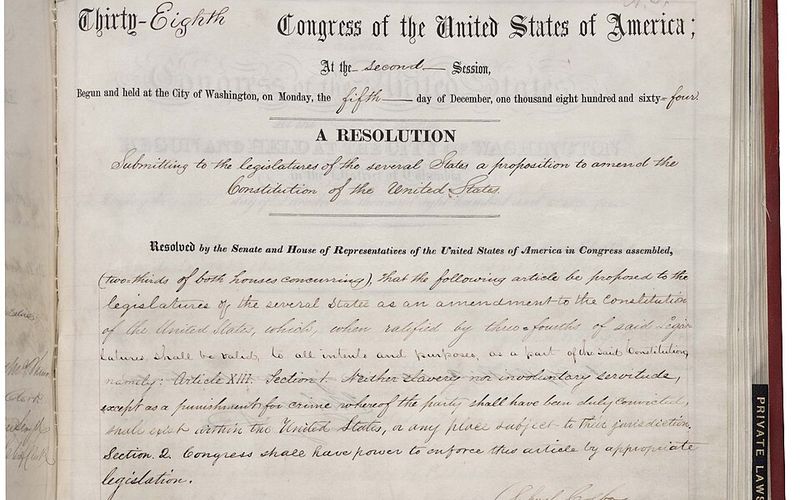
In the middle of the Civil War, Congress voted on a constitutional amendment to abolish slavery. It needed two-thirds of each chamber. The Senate cleared that bar in April 1864; the House fell short in June and passed it on a second try in January 1865.
Resulting law: 13th Amendment to the U.S. Constitution
From event to law
Who voted to abolish slavery, and who changed their vote? Open any vote below to see every legislator.
- EventJanuary 1, 1863
Emancipation Proclamation
President Lincoln declared enslaved people free in areas in rebellion. It did not reach the border states or end slavery by law.
- VoteApril 8, 1864
Senate passes the amendment
S.J. Res. 16 passes the Senate with more than the two-thirds required.
Senate, 38th Congress, roll call 134
38 yea6 nayPassedTwo-thirds needed: 30 of 44
See how every senator votedParty Yea Nay Republican 31 0 Democrat 2 5 Unconditional Unionist 4 0 Unionist 1 1 - VoteJune 15, 1864
House falls short
A majority of the House votes yes, but not the two-thirds a constitutional amendment requires.
House, 38th Congress, roll call 348
95 yea66 nayFailedTwo-thirds needed: 108 of 161
See how every representative votedParty Yea Nay Republican 77 1 Democrat 4 59 Unconditional Unionist 12 0 Unionist 0 6 Ind. Republican 2 0 - EventNovember 8, 1864
Election of 1864
Lincoln is reelected on a platform that called for the amendment.
- VoteJanuary 31, 1865
House passes the amendment
On reconsideration, the House passes the same resolution and sends it to the states.
House, 38th Congress, roll call 480
119 yea56 nayPassedTwo-thirds needed: 117 of 175
See how every representative votedParty Yea Nay Republican 84 0 Democrat 14 50 Unconditional Unionist 16 0 Unionist 3 6 Ind. Republican 2 0 - LawDecember 6, 1865
Ratified
Three-fourths of the states ratify. Secretary of State William Seward certifies the amendment on December 18, 1865.
Look up the votes
- Senators who voted no in 1864
- House members who voted no in June 1864
- The final House vote, January 1865
Party labels are those used at the time of the vote. The parties' coalitions and positions have changed over time, so a party name in 1864 or 1919 does not map directly onto the party today.
Sources
- National Archives: 13th Amendment
- U.S. Senate: Landmark Legislation, Thirteenth Amendment
- Voteview: Congressional Roll-Call Votes Database (vote tallies and member votes)
Tallies count members recorded as voting yea or nay. Official counts printed at the time can differ by a vote or two because of pairs and later corrections.