The Civil Rights Movement and the Civil Rights Act of 1964
Protests in Birmingham and the March on Washington in 1963 built pressure for federal civil rights legislation. President Kennedy proposed a bill in June 1963; after his assassination, President Johnson pressed for its passage. The Senate ended a filibuster by cloture for the first time on a civil rights bill.
Resulting law: Civil Rights Act of 1964 (Pub. L. 88-352)
From event to law
Which legislators were responsible for the Civil Rights Act, and who opposed it? Open any vote below to see every legislator.
- EventMay 3, 1963
Birmingham campaign
Police use fire hoses and dogs on young marchers in Birmingham, Alabama. Images of the response are broadcast nationwide.
- EventJune 11, 1963
Kennedy's address
President Kennedy tells the nation he will ask Congress for a civil rights bill.
- EventAugust 28, 1963
March on Washington
About 250,000 people gather at the Lincoln Memorial for jobs and freedom.
- EventNovember 22, 1963
Kennedy assassinated
President Johnson urges Congress to pass the civil rights bill in Kennedy's memory.
- VoteFebruary 10, 1964
House passes H.R. 7152
Two days earlier, the House added a ban on job discrimination based on sex, offered by Rep. Howard Smith (D-VA), by an unrecorded vote.
House, 88th Congress, roll call 128 · H.R. 7152
- VoteJune 10, 1964
Senate ends the filibuster
The Senate invokes cloture, the first time it did so on a civil rights bill.
Senate, 88th Congress, roll call 302 · H.R. 7152
- VoteJune 19, 1964
Senate passes its version
The Senate passes the bill with the Mansfield-Dirksen substitute.
Senate, 88th Congress, roll call 409 · H.R. 7152
- VoteJuly 2, 1964
House accepts the Senate version
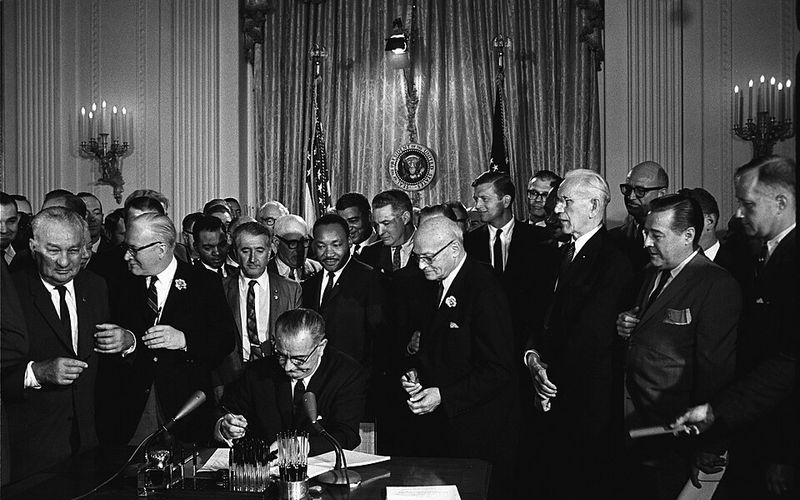
The House agrees to the Senate's changes and President Johnson signs the bill that evening.
House, 88th Congress, roll call 182 · H.R. 7152
Look up the votes
- House members who voted no
- Senators who voted to keep the filibuster going
- Senators who voted yes on passage
Party labels are those used at the time of the vote. The parties' coalitions and positions have changed over time, so a party name in 1864 or 1919 does not map directly onto the party today.
Sources
- U.S. Senate: Civil Rights Act of 1964 cloture
- National Archives: Civil Rights Act (1964)
- Voteview: Congressional Roll-Call Votes Database (vote tallies and member votes)
Tallies count members recorded as voting yea or nay. Official counts printed at the time can differ by a vote or two because of pairs and later corrections.