Selma and the Voting Rights Act of 1965
On March 7, 1965, state troopers attacked peaceful marchers on the Edmund Pettus Bridge in Selma, Alabama. President Johnson went before Congress a week later to call for a voting rights bill. The act banned literacy tests in covered areas and required federal approval of their voting changes.
Resulting law: Voting Rights Act of 1965 (Pub. L. 89-110)
From event to law
Who voted for the Voting Rights Act? Open any vote below to see every legislator.
- EventMarch 7, 1965
Bloody Sunday
Marchers bound for Montgomery are beaten by state troopers on the Edmund Pettus Bridge in Selma.
- EventMarch 15, 1965
"We Shall Overcome"
President Johnson addresses a joint session of Congress and calls for voting rights legislation.
- VoteMay 25, 1965
Senate ends debate
The Senate invokes cloture on S. 1564.
Senate, 89th Congress, roll call 67 · S. 1564
- VoteMay 26, 1965
Senate passes S. 1564
The Senate passes its bill the next day.
Senate, 89th Congress, roll call 78 · S. 1564
- VoteJuly 9, 1965
House passes H.R. 6400
The House passes its own version.
House, 89th Congress, roll call 87 · H.R. 6400
- VoteAugust 3, 1965
House approves the final bill
The House agrees to the conference report.
House, 89th Congress, roll call 107 · S. 1564
- VoteAugust 4, 1965
Senate approves the final bill
The Senate agrees to the conference report.
Senate, 89th Congress, roll call 178 · S. 1564
- LawAugust 6, 1965
Signed
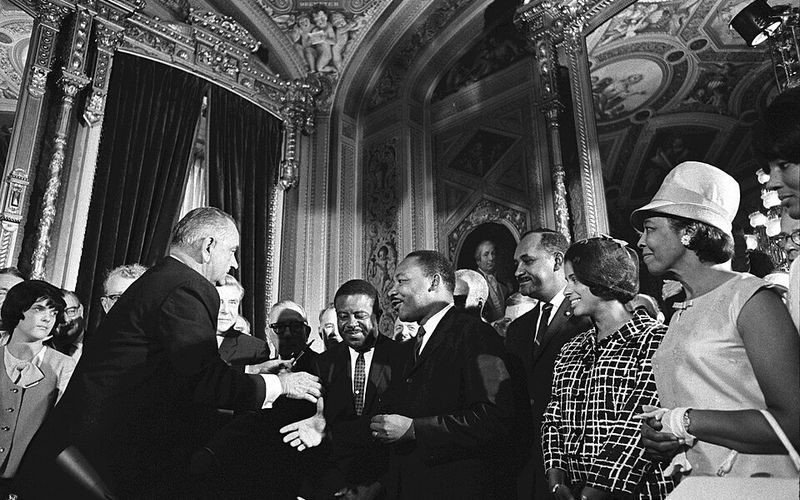
President Johnson signs the Voting Rights Act.
- CourtJune 25, 2013
Shelby County v. Holder
The Supreme Court strikes down the formula used to decide which areas needed federal approval of voting changes.
Look up the votes
Party labels are those used at the time of the vote. The parties' coalitions and positions have changed over time, so a party name in 1864 or 1919 does not map directly onto the party today.
Sources
- National Archives: Voting Rights Act (1965)
- U.S. Department of Justice: History of Federal Voting Rights Laws
- Voteview: Congressional Roll-Call Votes Database (vote tallies and member votes)
Tallies count members recorded as voting yea or nay. Official counts printed at the time can differ by a vote or two because of pairs and later corrections.