The 2008 Financial Crisis and the Bank Rescue
After Lehman Brothers collapsed in September 2008, the Treasury asked Congress for authority to buy troubled assets from banks. The House rejected the first version on September 29, and the Dow Jones average fell 777 points that day. The Senate passed a revised bill, and the House approved it on October 3.
Resulting law: Emergency Economic Stabilization Act of 2008 (Pub. L. 110-343)
From event to law
Who voted for and against the bank rescue? Open any vote below to see every legislator.
- EventSeptember 15, 2008
Lehman Brothers fails
The investment bank files the largest bankruptcy in U.S. history.
- VoteSeptember 29, 2008
House rejects the rescue
The first version fails. The Dow Jones Industrial Average falls 777 points.
House, 110th Congress, roll call 674 · H.R. 3997
- VoteOctober 1, 2008
Senate passes a revised bill
The Senate adds tax provisions and a higher deposit insurance limit, using H.R. 1424 as the vehicle.
Senate, 110th Congress, roll call 213 · H.R. 1424
- VoteOctober 3, 2008
House passes it
The House accepts the Senate bill.
House, 110th Congress, roll call 681 · H.R. 1424
- LawOctober 3, 2008
Signed
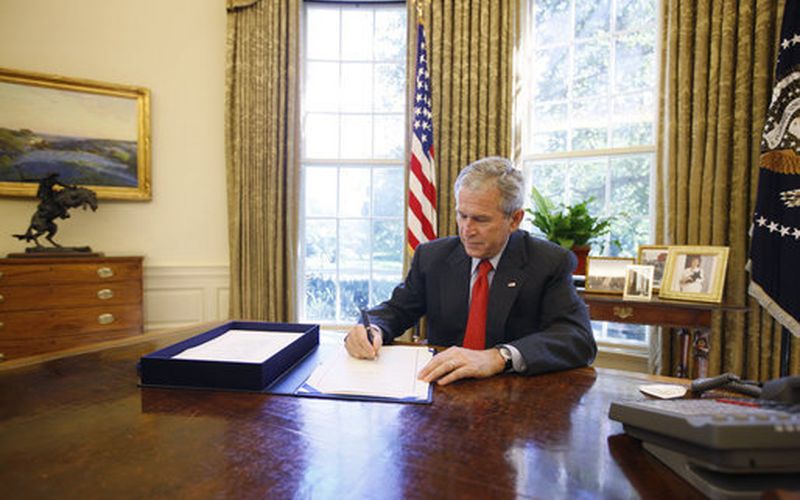
President Bush signs the act, creating the Troubled Asset Relief Program (TARP).
Look up the votes
Party labels are those used at the time of the vote. The parties' coalitions and positions have changed over time, so a party name in 1864 or 1919 does not map directly onto the party today.
Sources
- Congress.gov: H.R. 1424 (110th)
- U.S. Treasury: TARP programs
- Voteview: Congressional Roll-Call Votes Database (vote tallies and member votes)
Tallies count members recorded as voting yea or nay. Official counts printed at the time can differ by a vote or two because of pairs and later corrections.